
The simplest question we asked ourselves
When we built our matching, we asked ourselves one very simple question: how do you actually find the best therapist for you? And the most honest answer is this: through someone you trust. If your closest friend recommends someone, that's the best match there is. We'll be completely open about it, so if you have that option, use it.
But not everyone has that person. Some people don't know anyone who could recommend a good therapist, and some simply don't want to talk about it. Those are exactly the people we're here for. So we looked at what makes a good friend's recommendation so good: they know you, they know what you need, and ideally they also know the right therapist. It comes down to a blend: the human, personal side on one hand, and the precise professional specialization for your actual concern on the other.
That's exactly what our guided matching tries to capture. We ask about it interactively, with a lot of thought given to how it feels to use, so the whole thing feels good and right. So let's simply take a look.
You don't need to know your category
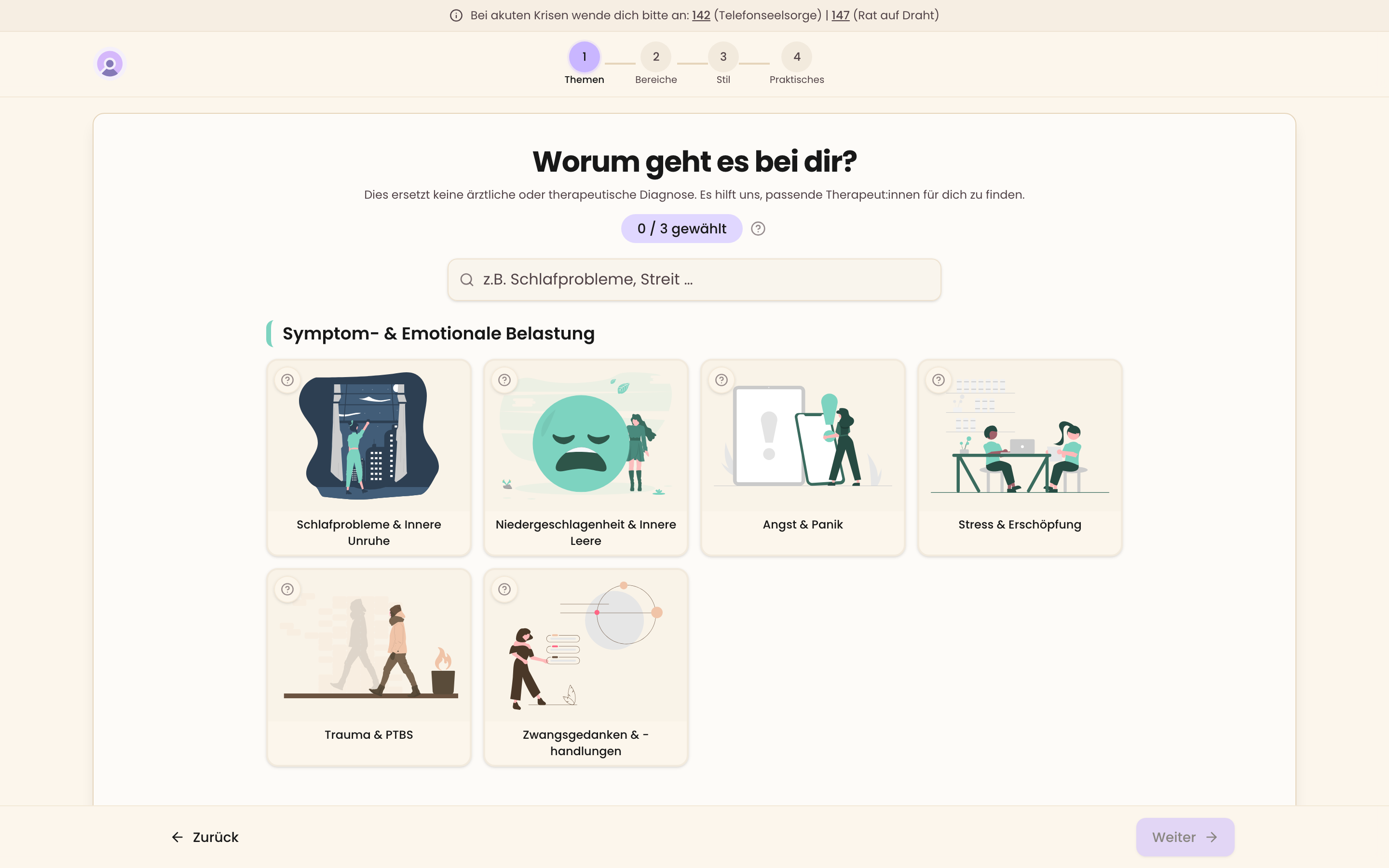
This matters a lot to us: you don't need to know which box your concern belongs in. No one has to show up with a diagnosis. If the technical terms mean nothing to you, just type what you're feeling in your own words at the top, and we'll show you what fits best.
A real example: you type "I get anxious when I go to sleep." In the background, the matching turns that into the closest topics, here "Sleep problems & inner restlessness" and "Anxiety & panic." All you have to do is confirm what feels right.
Step by step through the matching
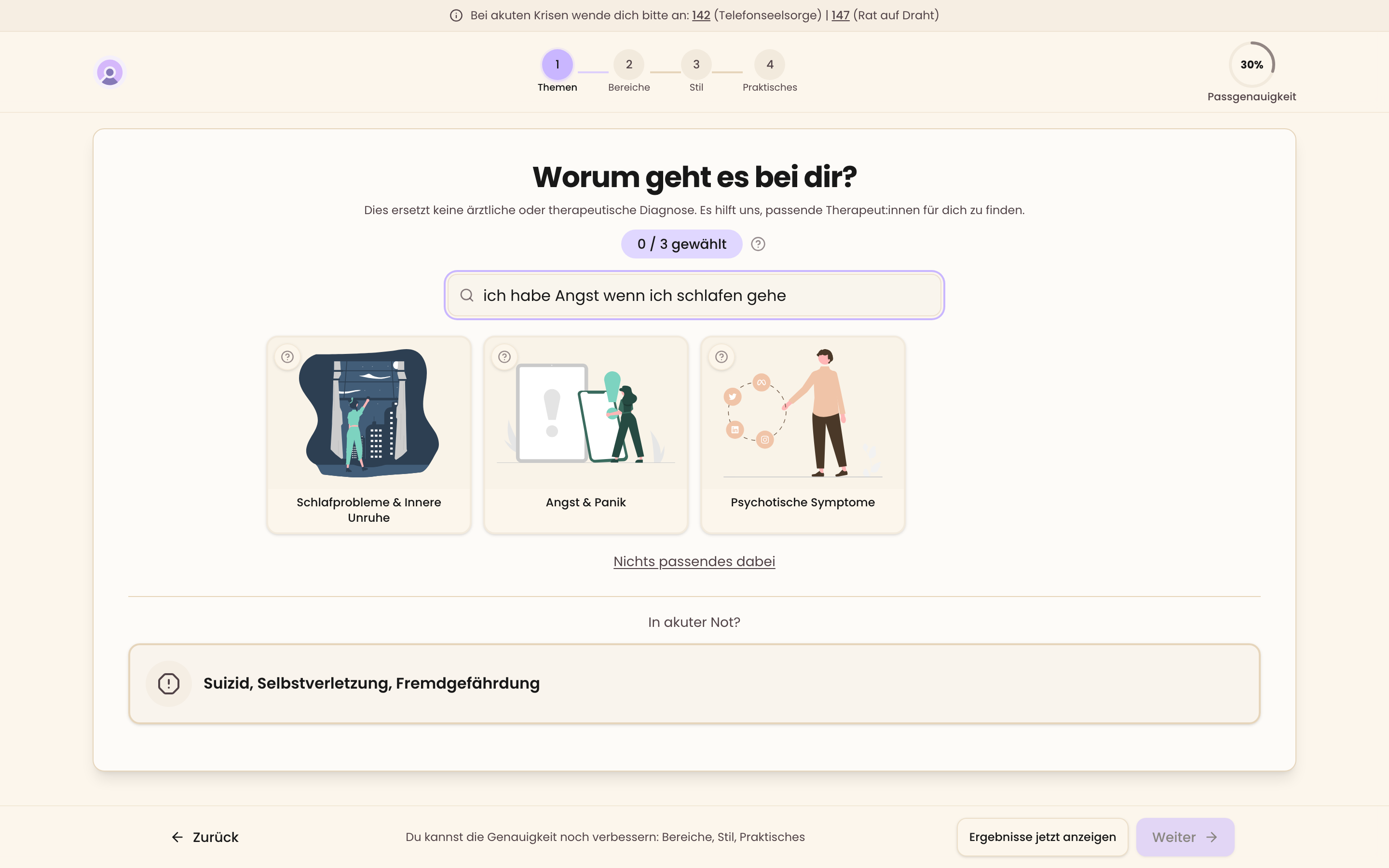
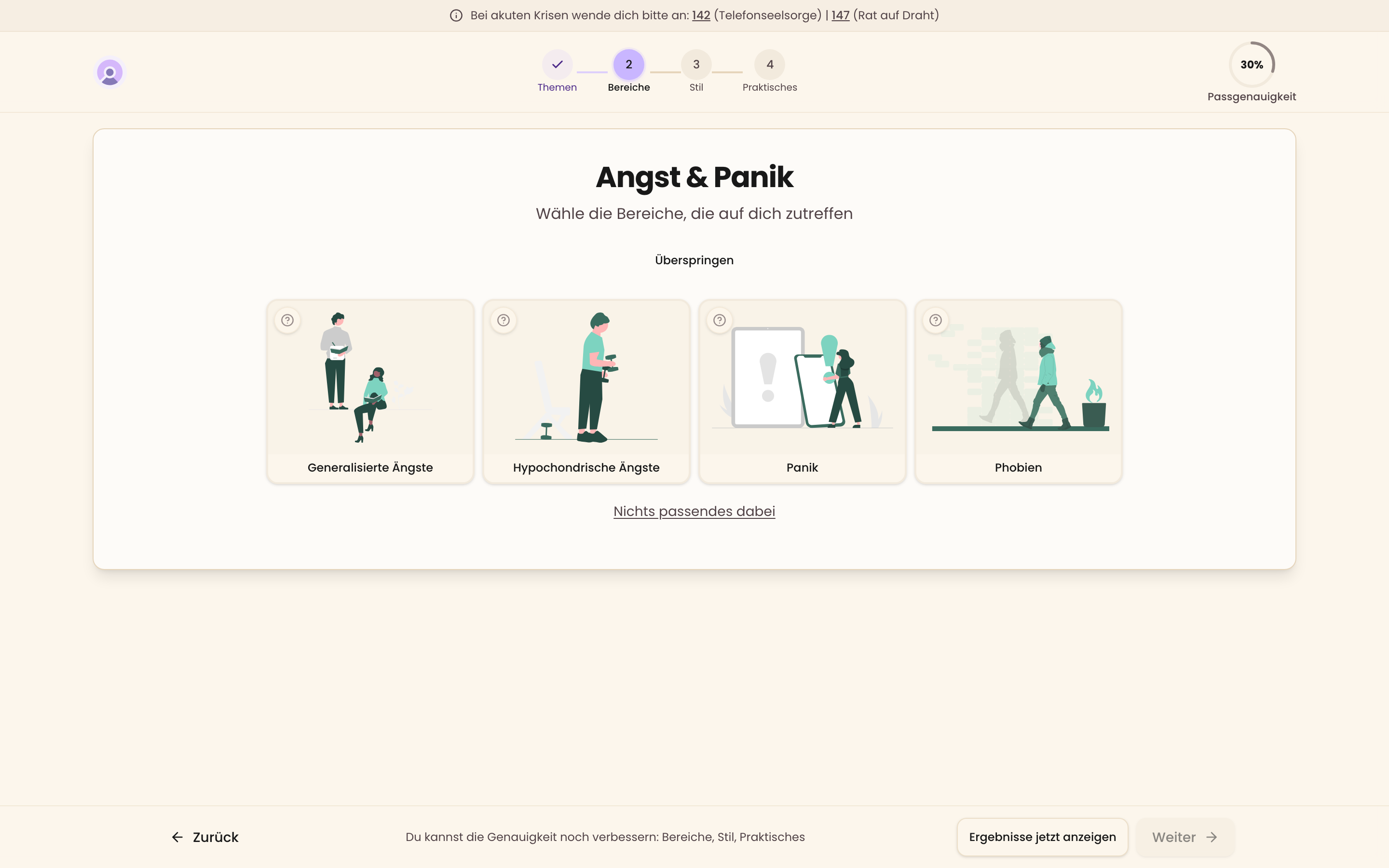
The matching has four short stages, and almost everything about it is optional. In the first step, you choose your topics. In the second, you narrow them down to specific areas, and you can skip that too, at any time, if none of it appeals to you.
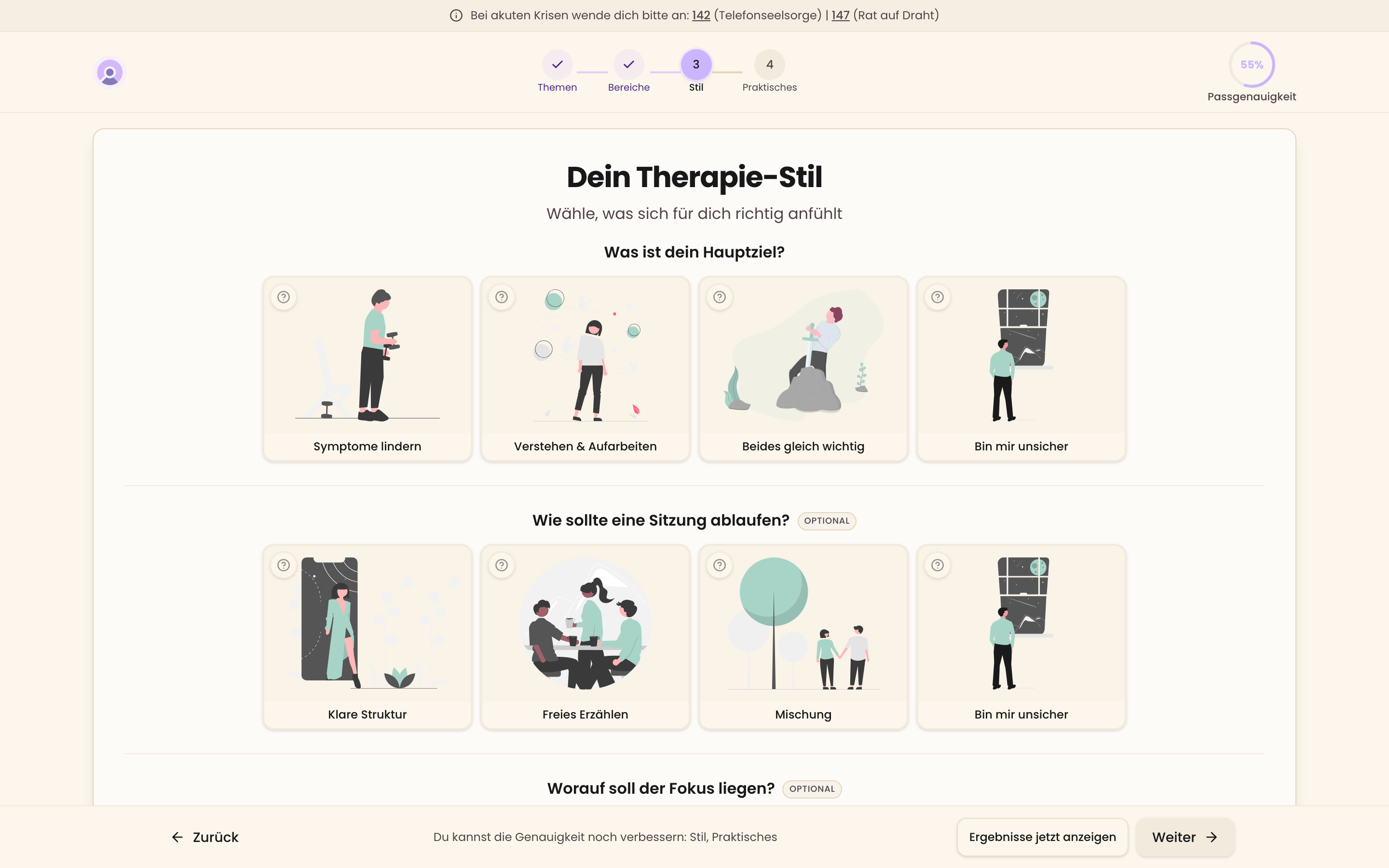
The third step is about style, and with it the very human side that matters so much. Do you want to ease your symptoms or understand them more deeply? Do you prefer clear structure or open, free-flowing conversation? Should the focus be on the present or the past? There's no right or wrong here, only what feels right for you.
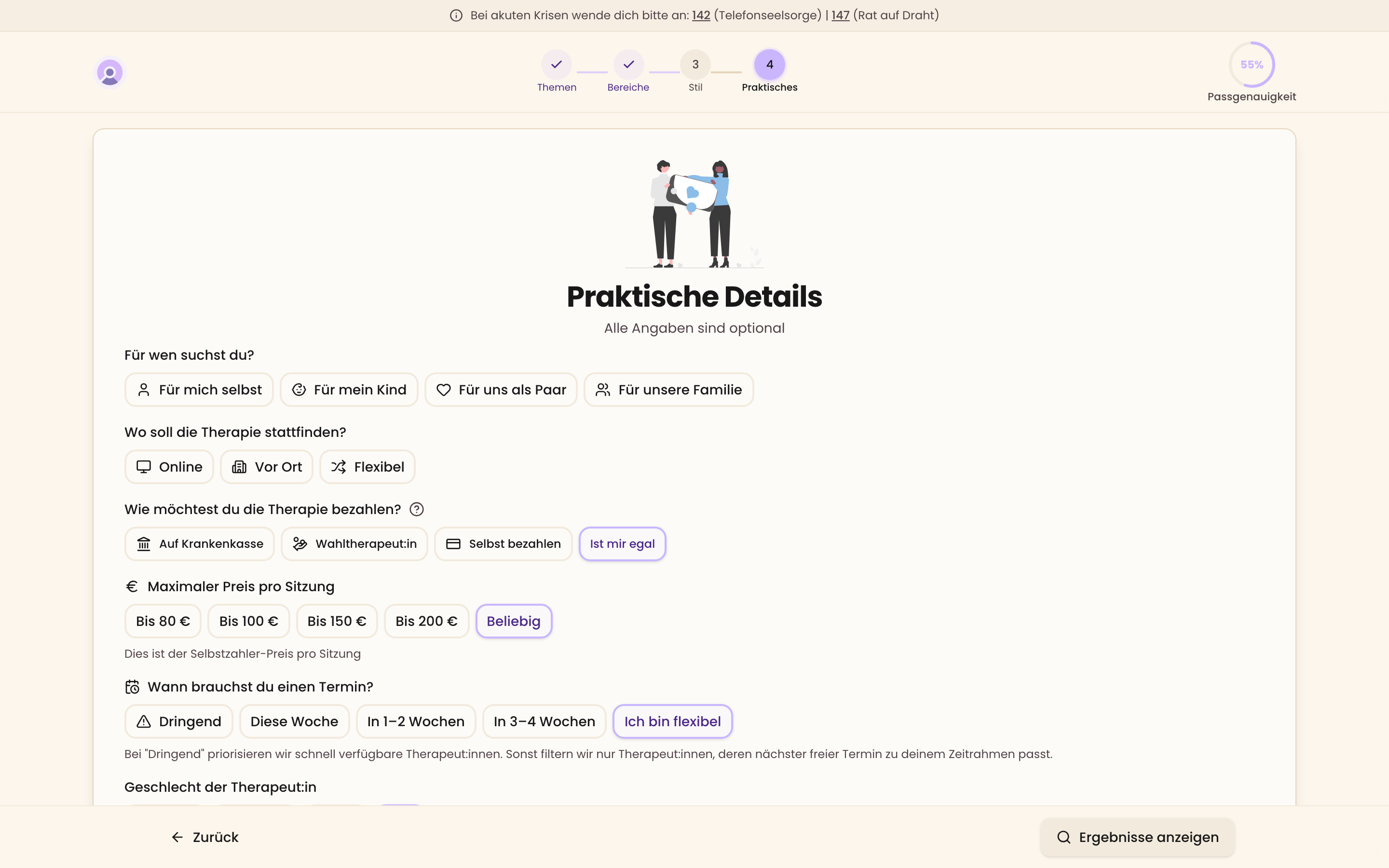
In the last step, we sort out the practical details: who you're looking for, whether it should be online or in person, your insurance status, a budget, and how quickly you need an appointment. This is optional too, but the more you tell us, the more precise the match becomes.
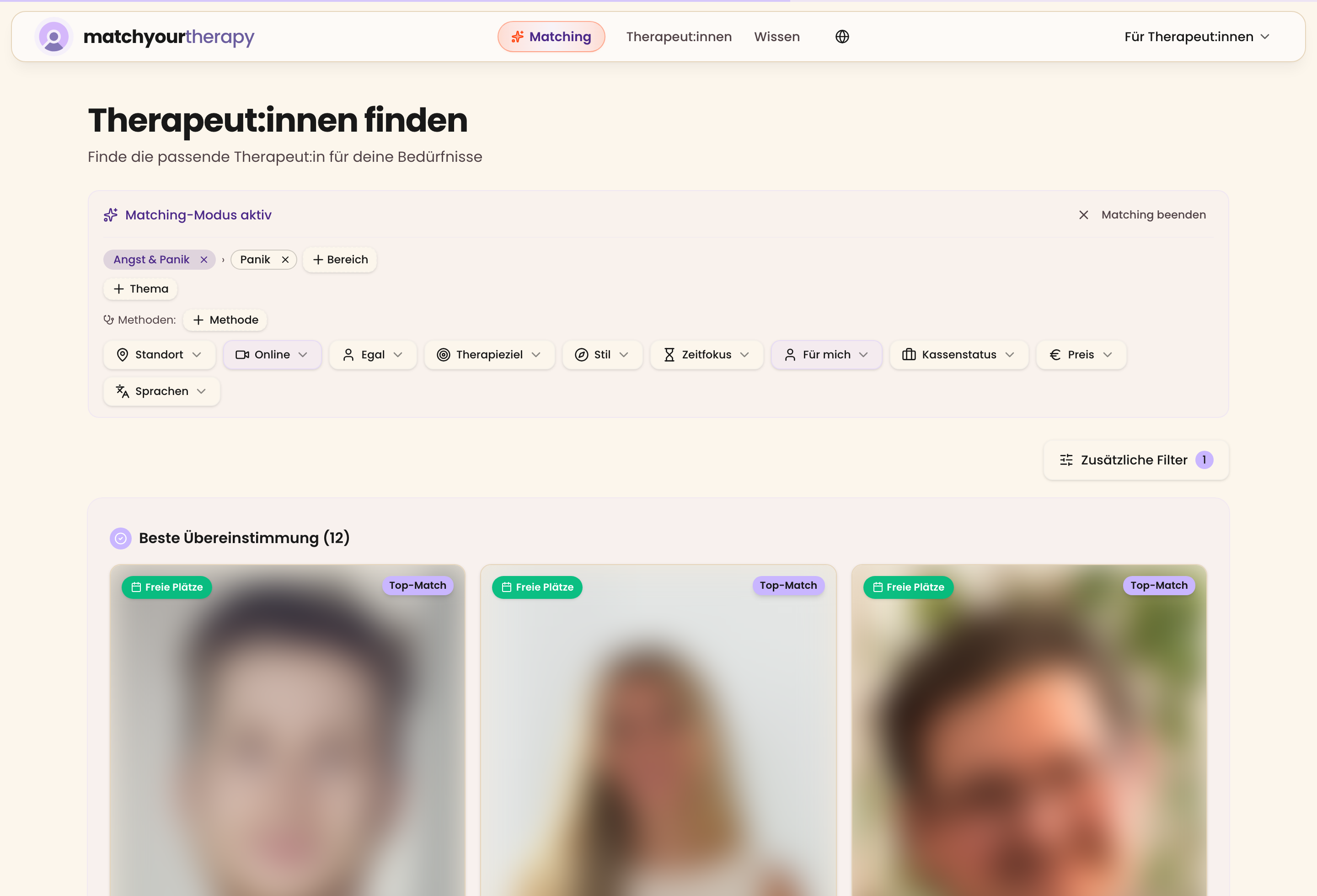
Your results, explained transparently
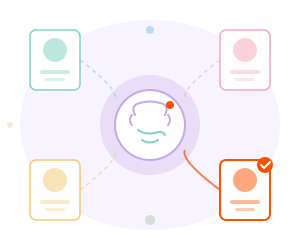
At the end, you don't get an endless list, but a selection sorted by how well each therapist fits: "Best match" first, then profiles with smaller and larger compromises. And, this matters to us, every card transparently shows "Why this match," explaining in plain words what fit. No black box, just a recommendation you can actually follow.
Compare, at your own pace
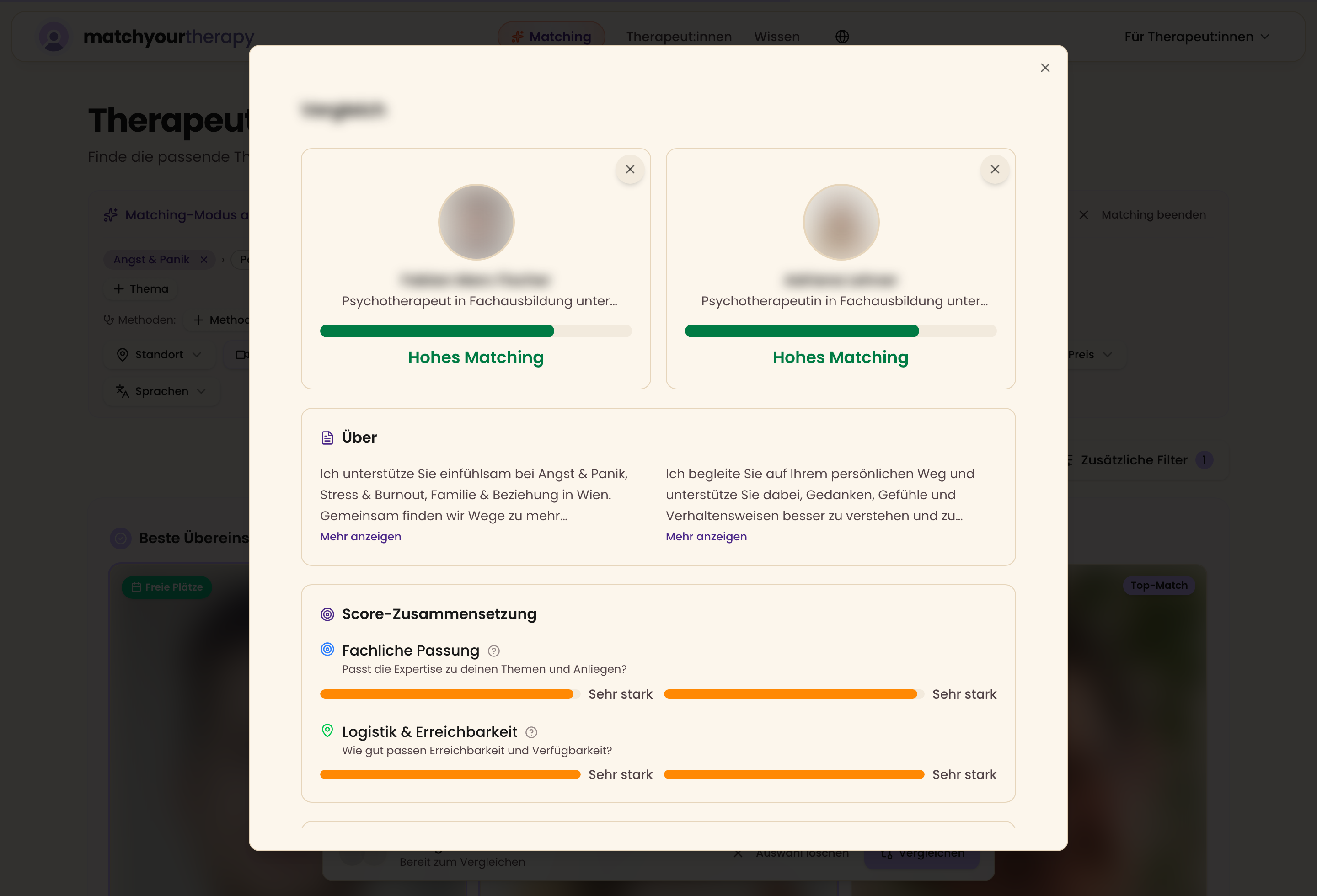
You don't have to decide right away. Just pick two or more profiles and compare them side by side, including a transparent breakdown of the score that shows how much the professional fit, the logistics, and the remaining factors each count toward it.
For the technically curious
Now for a brief technical detour. Our algorithm is deliberately modeled on dating platforms, not as a gimmick, but because the human connection in therapy simply matters so much. The research here is remarkably clear: the quality of the relationship between therapist and client is one of the strongest predictors of whether therapy works, often at least as much as the specific method. That's exactly why the fit between two people should never get lost with us.
That's why we've given the different factors different weights, based on our review of the research. These weights aren't rigid: if you're in a hurry, the practical side moves to the front; if you set a firm budget, price counts for more.
Then come the filters, and there are two kinds. Hard filters are non-negotiable: if you can only do online sessions, in-person-only practices drop out; if you're looking for your child, we only show therapists who work with children. Soft filters, on the other hand, are exactly that, soft. If we can't find an exact match for what you entered, they loosen gently instead of showing you an empty list.
An example: you're searching within a 10 km radius. If there's no ideal professional match there, the boundary moves outward a little, and a therapist working 13 km away still appears, clearly labeled under "Small compromises," instead of simply disappearing. Personal things like gender or language are the last we loosen, because they count the most. So there's a whole lot of logic behind the scenes, with the single goal of showing you the best possible match.
No sign-up, no stored data
And here's the most important thing up front: you don't need an account for any of this. No registration, no email, no password. As you click through the matching, nothing about you is stored; your selections live only in your browser. You can run through it as often as you like, completely anonymously.
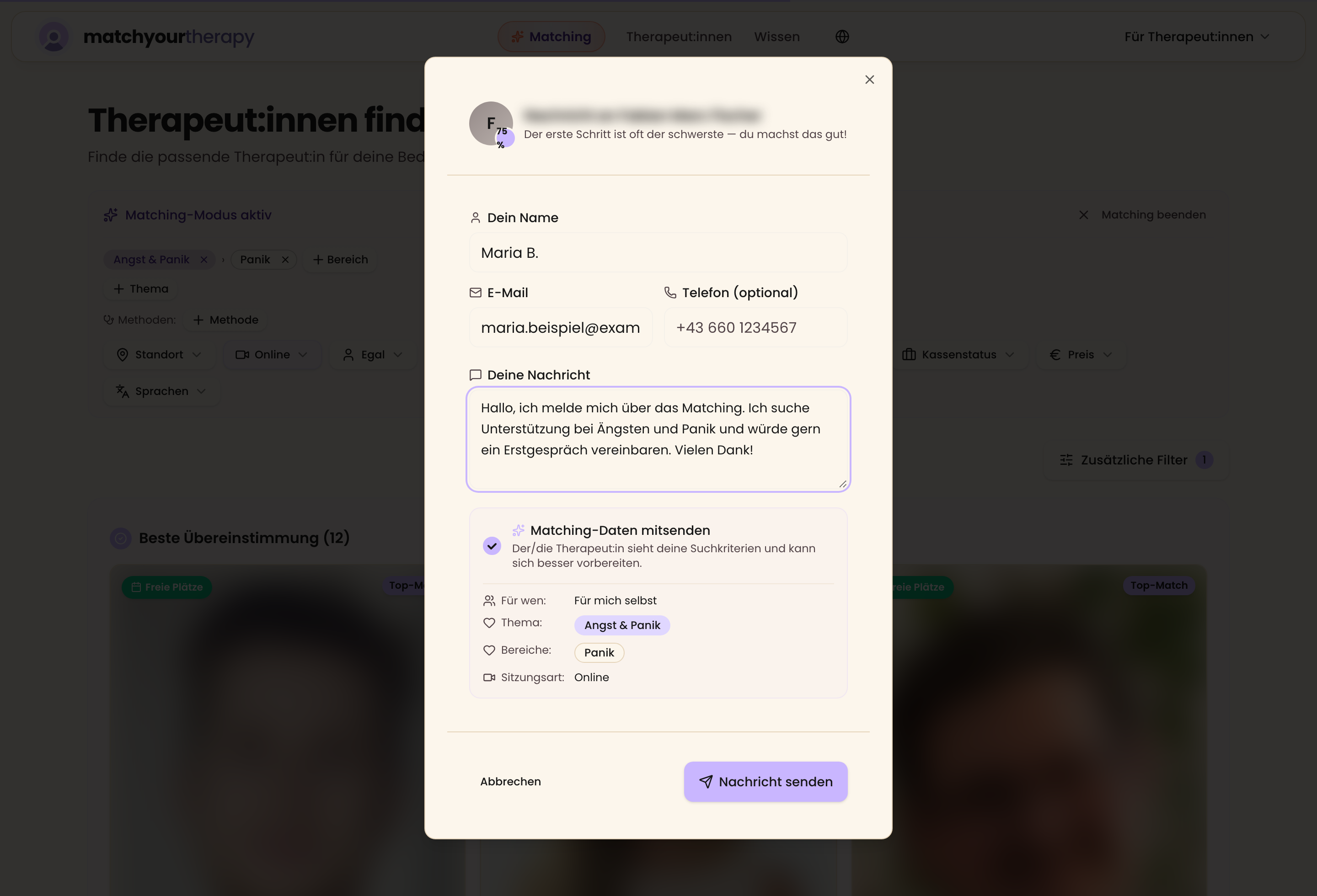
Only when you decide to contact a therapist do you enter your contact details. And even then, the choice is yours: with a single checkbox, you decide whether the insights from your matching are sent along or not. If you include them, the therapist can prepare for you better. If you leave them out, they receive only your message, nothing more.
Encrypted from start to finish
For us, data protection isn't fine print. We encrypt every request properly using the established AES-256-GCM standard before it's ever written to our database. The notification to the therapist contains no readable text, only a login link; they see the content decrypted only once they're with us on the platform. So if you're a therapist receiving a request, you read it directly on our platform, not in your email inbox. Even in the event of a complete database breach, all that would sit there is useless ciphertext.
We've written out exactly how this works, openly, on our security page: GDPR-compliant, on EU servers, and with no personal plain-text data in our logs. Your search for therapy is a private matter, and we treat it that way technically too.
We keep improving it
In theory, all of this sounds well and good. But as always: what really counts only becomes clear once real people use the matching. That's exactly what we're prepared for; we want to keep improving this process. And that's where you come in: if you have an idea, something isn't working, or something's missing, just email us at info@matchyourtherapy.at. We're genuinely thrilled about every piece of feedback.